Lakehouse capabilities in AI Data Platform
Oracle AI Data Platform brings structured, semi structured, and unstructured data together in a governed environment, including Autonomous AI Lakehouse as an open, interoperable foundation for data, analytics, and AI. Data can remain where it lives or move through governed pipelines, creating a trusted, AI-ready foundation for analytics, machine learning, and AI agents without unnecessary duplication.
Create a trusted data foundation for AI
-
One lakehouse across all your data
Bring structured, semistructured, and unstructured data together in one governed environment. Connect to data where it lives, with Autonomous AI Lakehouse available for open, managed lakehouse workloads. Produce, consume, and transform data using Apache Iceberg or Delta Lake. Extend your data estate instead of creating another silo.
-
Unified developer experience
Use managed Apache Spark to prepare and refine data, and then use Oracle Autonomous AI Lakehouse to deliver curated data optimized for analytics, machine learning, and AI agents. A connected path from raw data to agents reduces platform switching, avoids data movements, while helping you choose the right storage at the right cost for the right use case and performance SLA.
-
Trust built into every stage
Apply consistent access controls, cataloging, lineage, and built-in security as data moves from raw input to trusted data products. Data engineers can track provenance, change, and authorized use. Users and AI workloads share the same governed foundation, while Autonomous AI Lakehouse can protect sensitive data, audit access, and enable secure sharing without duplication.
Explore the lakehouse features and capabilities in AI Data Platform
Build a complete data lakehouse for structured, semistructured, and unstructured data. Access existing data in place or ingest raw data into object storage as the bronze layer, reducing unnecessary duplication. Managed Apache Spark, with autoscaling compute, cleans, standardizes, and enriches data into trusted silver-layer data sets. Publish curated, AI-ready gold-layer data through Oracle Autonomous AI Database, including Autonomous AI Lakehouse, for analytics, machine learning, and AI agents. Autonomous AI Lakehouse adds managed operations and open interoperability through Apache Iceberg. Shared cataloging, lineage, and access controls give data engineers, data scientists, AI developers, and business users a consistent, governed data foundation.
Connect all your data
Zero copy connectivity to any sources, any sinks, any language, anywhere
Catalog and connect to more than 100 sources and sinks, including relational databases, SaaS applications, streaming feeds, and third-party data providers. For example, a data engineer can combine ERP records, customer events, and clickstream data into Apache Spark transformations, and then land trusted gold tables in the lakehouse.
Converged analytics across data and databases
Query structured tables, semistructured JSON, geospatial data, and AI vector embeddings across object storage and connected databases under one role-based access control model. Autonomous AI Lakehouse extends this approach to open lakehouse data, allowing business users to join activity streams with authoritative customer records in Oracle Autonomous AI Database through a single SQL query.
Build trusted pipelines
Visual data pipeline creation
Design no-code and pro-code ETL and ELT pipelines that orchestrate ingestion, transformation, and enrichment from bronze to gold in a single workflow.
Best-in-class engines for data preparation and queries
Data engineers can run large-scale data transformations in Apache Spark. Data scientists can build ML models. Business users can perform ad-hoc exploration using SQL and Oracle Autonomous AI Database against the same data. Each user can pick the right engine for their workload without copying or remodeling data.
Stay open and interoperable
Interoperability with open file formats
Store and query data in open formats, including Apache Iceberg and Delta Lake, directly on Oracle Cloud Infrastructure (OCI) Object Storage, with transactional consistency, time-travel queries, and schema evolution. Interoperate with Apache Spark, Apache Flink, and any engine compatible with Apache Iceberg or Delta Lake. For deployments using Autonomous AI Lakehouse, teams can also access Apache Iceberg tables across cloud environments and catalogs with high performance. There’s no proprietary lock-in, and teams can change compatible tools without rewriting their data.
Discover data across catalogs and clouds
Use Autonomous AI Lakehouse and Autonomous AI Database Catalog to bring together metadata from lakehouse catalogs and enterprise data platforms. Data engineers can discover Iceberg data across clouds, understand available assets, and access them through a unified view without rebuilding existing catalogs.
Scale lakehouse performance automatically
Accelerated queries over data in place
Use Autonomous AI Lakehouse with Data Lake Accelerator to speed large scans across Iceberg tables and object storage data. The platform adds compute and network capacity as needed, so teams can run demanding analytics and AI workloads without sizing infrastructure for peak demand.
Power agentic actions with trusted data
Same governed gold layer for every AI workload
Build AI on private data your business already trusts. Use AI Database 26ai as the repository for curated gold data. AI Data Platform brings the curated, validated data into this governed gold layer that powers analytics, machine learning, RAG applications, and AI agents from the single, consistent source of truth. Give every model the business context it needs without duplicating data sets or relying on disconnected copies. Leverage the self-tuning, self-scaling, and self-repairing data warehouse with automatic indexing, query optimization, and workload management. Deliver consistent, subsecond performance across billions of rows during peak hours without manual tuning.
Build agents that connect insights to actions
Move beyond chat experiences to agents that can reason, retrieve information, and take action within business workflows. Build visually with a graph of triggers, agents, guardrails, and tools, or build in code with LangGraph and Python. Create single-agent or multi-agent flows with defined roles, instructions, memory, and tool access. Ground agents in enterprise knowledge through RAG and vector search, query governed business data through parameterized SQL, and act through REST APIs, remote MCP servers, and custom Python tools. Test behavior in the playground, inspect traces before release, then deploy endpoints and monitor latency, sessions, token use, and production interactions within the same workspace and governance boundaries.
Integrate and share
Zero copy, zero ETL data sharing
Share live lakehouse data with teams, partners, customers, applications, and agents without copying or moving data. Ensure that every consumer has the most current, authoritative version. Build enterprise AI agents that combine data and agents from multiple Oracle Applications as well as external data sources and agents.
Tightly integrated with Oracle Applications
Bring Oracle Fusion Applications data, including ERP, HCM, supply chain, and CX, directly into the lakehouse. Prepare Fusion data in Apache Spark–powered notebooks for AI agent grounding, historical reporting, and predictive analytics on the operational system of record.
Data sharing
Share live lakehouse data with internal teams, partners, and Oracle Applications without copying or moving it. Data sharing helps keep every consumer on the most current, authoritative version. Deployments using Autonomous AI Lakehouse have secure, real-time sharing through the Delta Sharing protocol.
Protect sensitive data without slowing teams
Built-in security and auditing
Secure Autonomous AI Lakehouse with automatic encryption and enforced authentication. Use a unified security control center to identify and mask sensitive data, audit critical database activity, and alert teams to risky users, configurations, and access attempts.
Operate the lakehouse without manual administration
Autonomous operations for data and AI workloads
Autonomous AI Lakehouse automates provisioning, securing, tuning, scaling, patching, backup, and repair. Teams can focus on delivering trusted data products and AI workloads instead of managing the underlying data infrastructure.
See AI Data Platform’s lakehouse capabilities in action
Connect to data where it lives
Connect AI Data Platform to external sources and synchronize metadata without unnecessarily copying the underlying data.
Unify structured and unstructured data
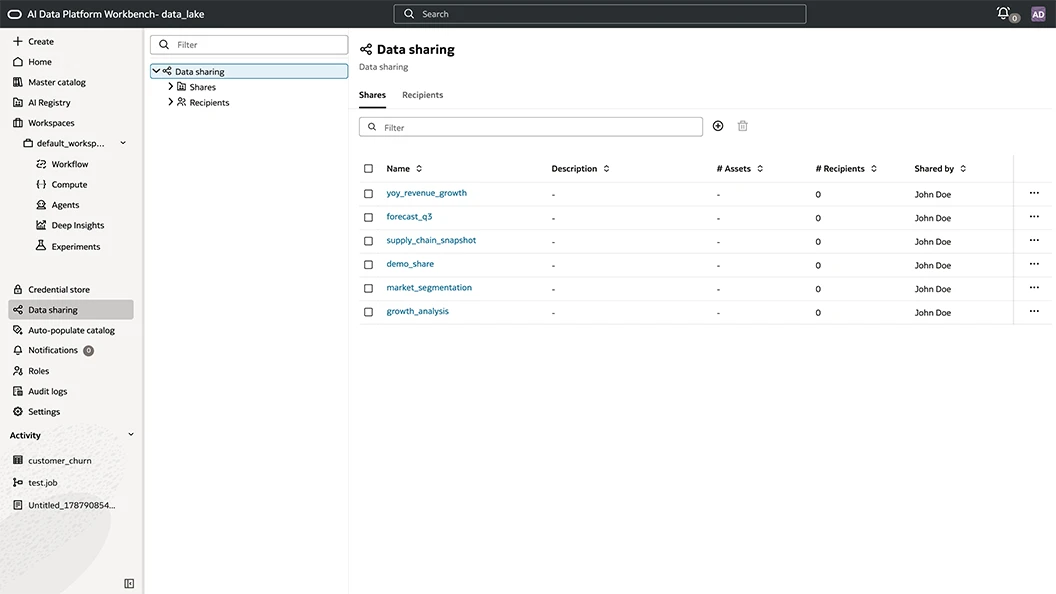
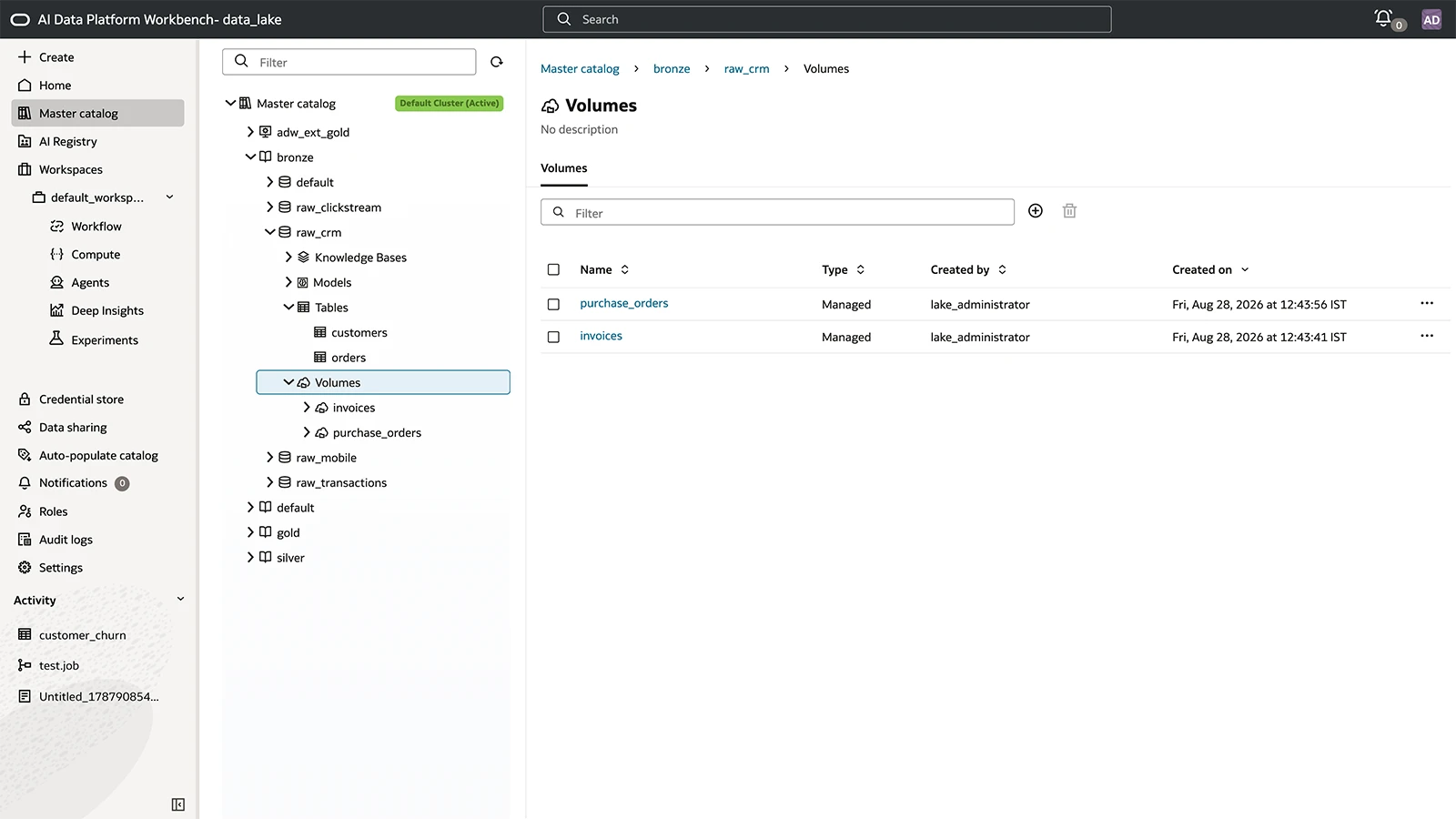
Organize structured data in tables and unstructured data in volumes, with managed and external options for both. Build a common foundation for analytics and AI.
Turn data into predictive insights
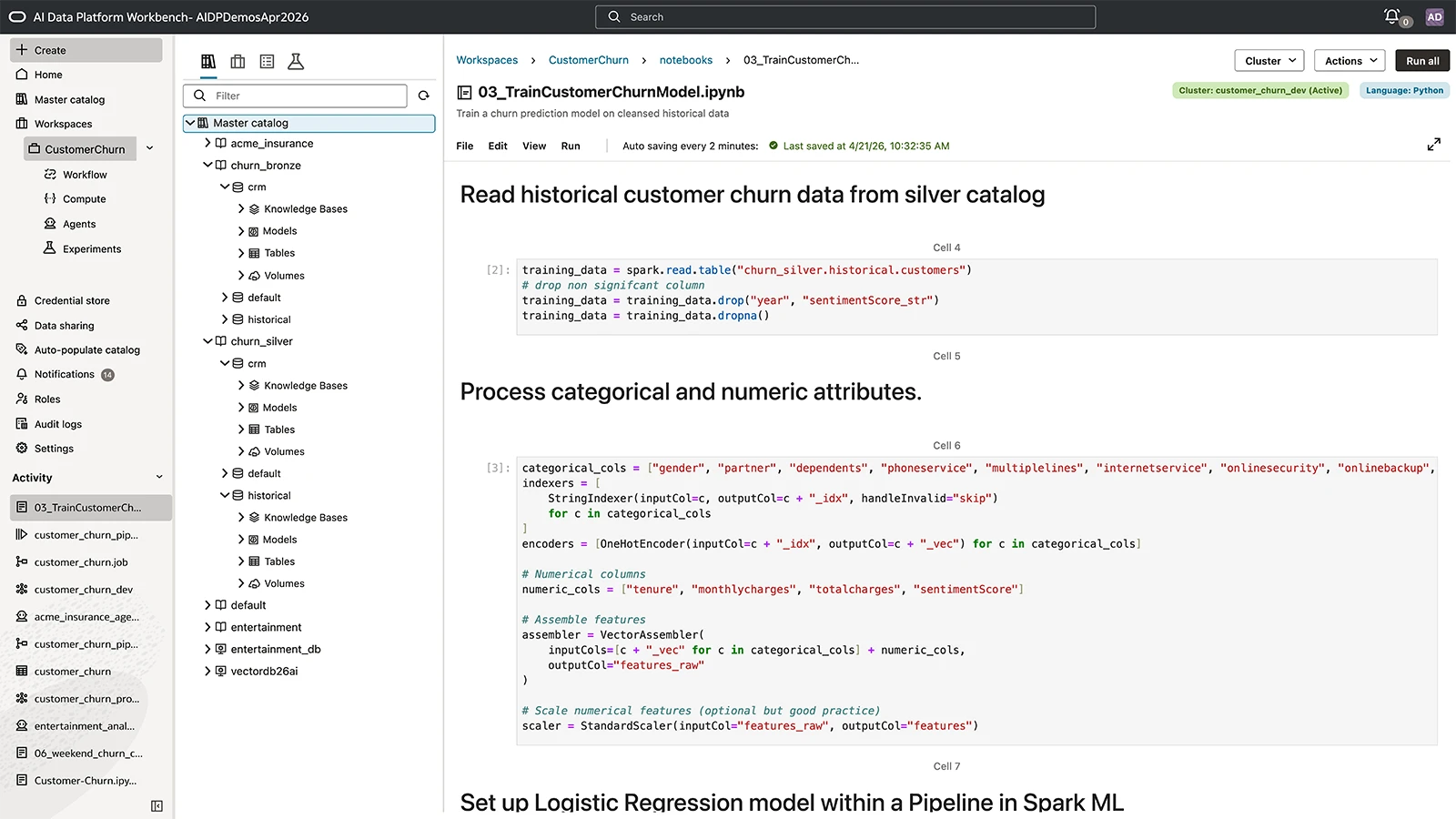
Prepare data and train machine learning models in Apache Spark notebooks.
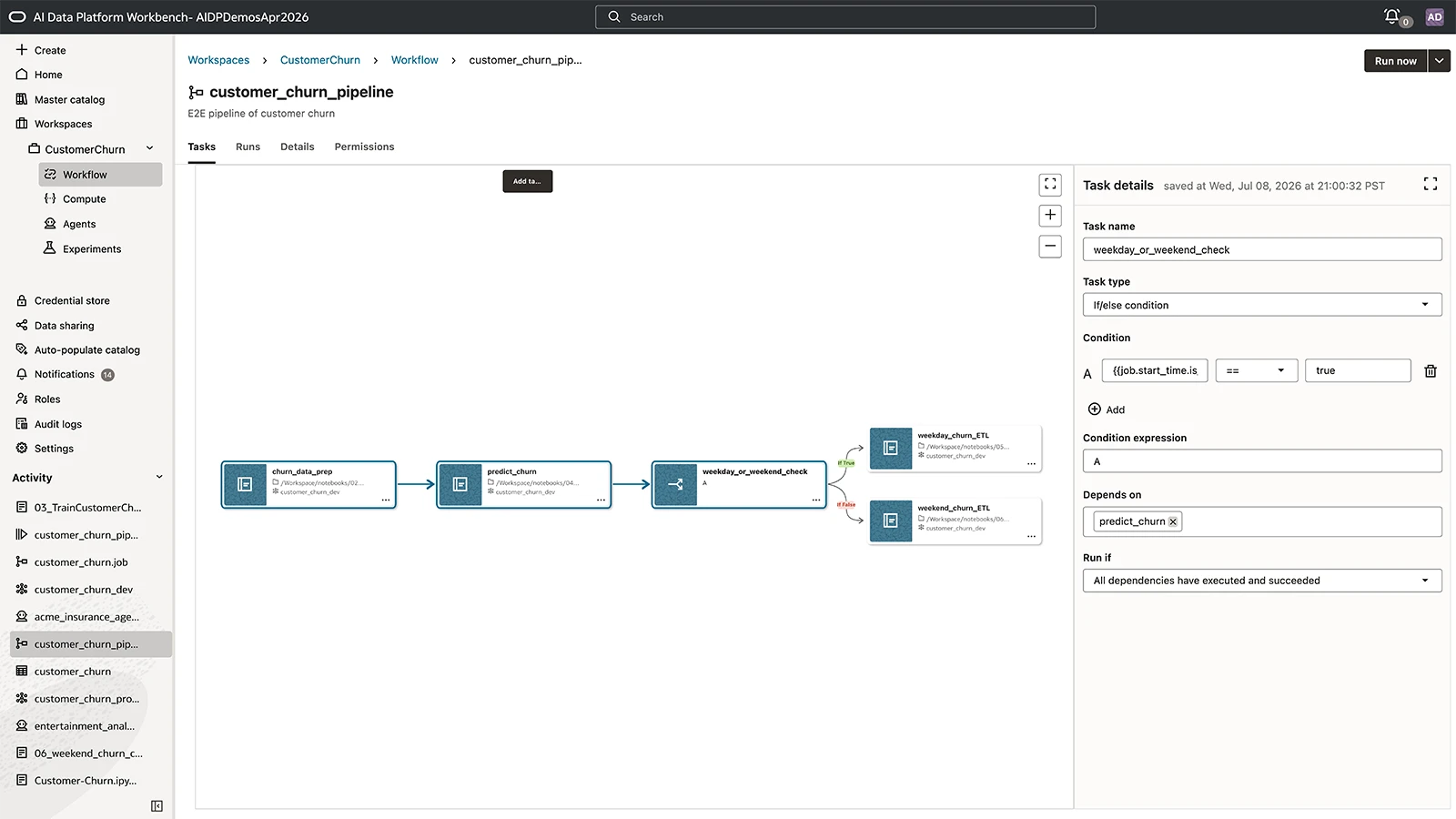
Automate data workflows visually
Connect tasks and apply conditional logic to orchestrate repeatable data workflows
Share trusted data without duplication
Securely share data across teams and projects without copying or moving it, keeping consumers connected to the same governed foundation.
Featured AI Data Platform blogs
Agents vs. Workflows: Where Does the ROI Actually Live?
Most enterprises aren’t failing with AI agents because of the technology—they’re failing because they’re using agents where simple workflows would do the job better. This blog explains the key differences between workflows and autonomous agents, and how choosing the right approach impacts ROI, scalability, governance, and cost. It also provides a practical framework for deciding when agentic AI is truly worth the investment.

-
September 18, 2026
Agents, Tools, and Skills: A More Efficient Approach to Enterprise AI
-
August 12, 2026
Your Data Already Knows the Answer. Now It Can Act on It.
-
June 30, 2026
Oracle Leads Across ISG Research AI and Data Platform Categories